An SDR who’s good at their job spends 80% of their week on the same five tasks: research the prospect, write the intro, send the intro, write a follow-up, write another follow-up. The work isn’t hard. It’s just slow, and it doesn’t scale with headcount. Every team we work with eventually asks the same question: what if the first 30 days of a prospect’s journey ran without a human in the loop, and the human only stepped in when there was a reply worth their time?
That’s what the SDR Agent does. This post is about the Salesforce-native version of it — built on Agentforce’s Customer Engagement Agent using the Buyer Engagement template, sending email through Marketing Cloud Advanced, grounded in Data Cloud. Everything below is real, currently shipping, and constrained by the Spring ’26 pilot guide. The constraints are the most interesting part.
01 — The Shape of the Solution
One autonomous loop
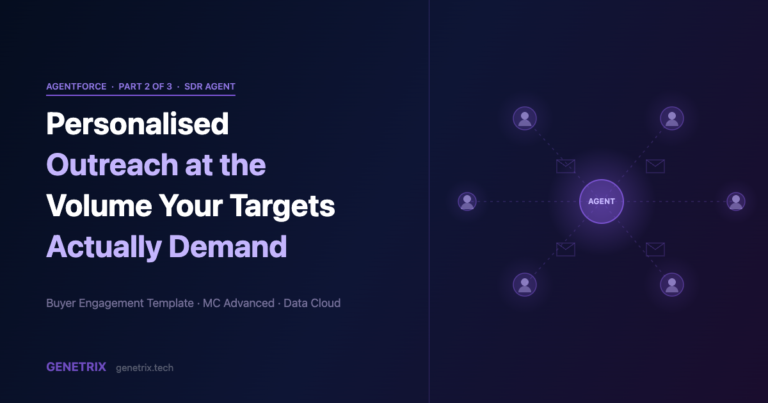
The Customer Engagement Agent is Salesforce’s productised answer to “outbound SDR + reply handling + meeting booking” as a single autonomous loop. The Buyer Engagement template — the only one in the Spring ’26 pilot — is purpose-built for high-volume nurture against Marketing Cloud campaigns.
The runtime story is simple. A Lead enters a Marketing Cloud campaign segment. The Campaign’s flow includes a “Forward to Bot/Agent” step. The agent picks up the Lead, reads the Campaign Brief and any associated Data Library content, generates a personalised intro email, and sends it through the authenticated domain. The Lead either replies (in which case the agent handles conversational turns and can offer a meeting booking link) or doesn’t (in which case the agent nudges on a configured interval until it exhausts the configured attempts or the Lead opts out).
The trick — and the reason this isn’t just “Salesforce mail merge with extra steps” — is that the personalisation is fully generative. The agent doesn’t fill in merge fields. It writes the email, grounded in the Campaign Brief, the Lead’s record, and your brand voice as configured in the agent’s core messaging.
02 — The Prerequisite Stack
The agent is the smallest part of the work
The Buyer Engagement template doesn’t run in isolation. It sits on top of a non-trivial stack of platform capabilities, all of which need to be enabled and configured before the agent itself can be turned on. This is the single biggest reason POCs slip on this product.
| Layer | Requirement | Why It Matters |
|---|---|---|
| Edition | Enterprise or Unlimited + MC Advanced | Required for all agentic capabilities |
| Platform | Agentforce enabled | Flex Credits + Data 360 Credits at runtime |
| Data | Data Cloud + Identity Resolution on Individual | Unified Individual IDs required to address Leads |
| Messaging | Agentforce Contact Center Digital | Required even when you only care about email |
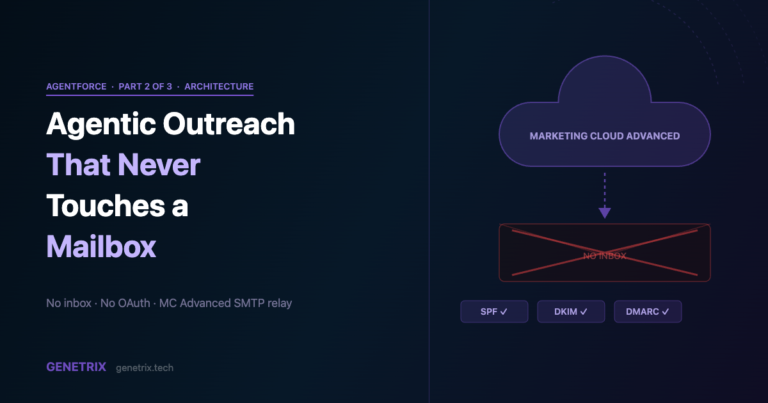
| Deliverability | Authenticated sending domain | SPF + DKIM published in DNS |
| Compliance | Communication Subscriptions | Consent capture surfaced on Lead |
Skip any one of these and the agent either won’t activate or will fail silently at runtime. The order matters too — Data Cloud must be set up before Identity Resolution can run; Identity Resolution must complete before the agent can address Leads; the authenticated domain must verify before the agent can send.
03 — Architecture
Three layers, one loop
architecture.txt
DATA LAYER
  Lead Record (SF Sales Cloud)
  Unified Individual (Data Cloud + IR)
  Data Library (Brand assets)
  Campaign Brief (MC Campaign)
        ↓
AGENTFORCE RUNTIME
  Buyer Engagement Agent
  Core messaging · Tone · Rules
  + Trust Layer (PII, ZDR, Toxicity)
  Forward to Bot/Agent (MC Flow Step)
  Reply Management → Fallback queue
        ↓
SEND & CAPTURE
  Authenticated Domain (SPF + DKIM)
  Lead Inbox (Personalised email)
  Messaging Session (Activity Timeline)
04 — Configuring the Agent
Six screens, two matter most
The guided configuration is one of the genuinely good parts of this product. Salesforce Go presents the Buyer Engagement template as a step-by-step wizard:
Getting Started — agent user record, agent name, language (English only in pilot).
Core Messaging & Positioning — company name, short description, primary value proposition, three to five key achievements, optional custom engagement rules (max 20 per agent).
Product Knowledge (optional) — the Agentforce Data Library, where you upload tone references, brand documents, and factual content the agent should ground its replies in.
Channel Conversation Settings — tone for web chat, tone for email, From address, communication subscription, maximum email attempts, nudge interval.
Web Chat, Qualification & Meeting Booking — all optional, all skippable for an email-first POC.
Review and Activate.
The two screens that disproportionately determine output quality are Core Messaging and Channel Conversation Settings. Both are short forms, but both reward iteration — we typically run three or four cycles of test sends and refinements before activating against a real audience.
05 — Wiring It Into a Campaign
The Forward to Bot/Agent step
Once the agent is active, open or create a Campaign in Marketing Cloud, attach a Campaign Brief (campaign goals, target audience, key messages, optional brand kit association), and edit the campaign Flow.
In Flow Builder, drop a Forward to Bot/Agent step at the point you want the agent to begin. The step has three knobs:
Routing: Agentforce Service Agent
Agent: pick the Buyer Engagement agent you just activated
Mode: Initiate Conversation (for outbound nurture) or Manage Replies (for handling inbound responses on already-active threads)
06 — What Runtime Actually Looks Like
A typical Lead’s journey
Day 0
Lead enters segment. Agent sends a personalised intro email from the authenticated domain. The mandatory AI disclosure appears at the top; the default legal signature at the bottom.
Day 3
No reply. Agent sends nudge #1 — a different email, grounded in the same Brief but written fresh.
Day 7, Day 12, Day 18
Further nudges per the configured interval and maximum attempts.
Any day — Reply
Agent immediately stops nudging. If configured for Manage Replies mode, it generates a contextual response. If the message expresses buying intent, the agent offers a meeting booking link (if enabled).
Any day — Unsubscribe
Email Opt Out is set on the Lead; agent exits the cadence.
07 — Pilot Limitations to Plan Around
Ten constraints that shape design decisions
1. The Lead Nurturing template is not in pilot
The Customer Engagement Agent has two templates — Buyer Engagement and Seller Engagement. The Seller Engagement template (formerly called Lead Nurturing) is not part of the Spring ’26 pilot. Reconcile terminology before you start.
2. English only
All agent output is in English. A multi-language audience needs separate campaigns per language with non-agent flows.
3. You can’t cancel outreach once it starts
Once a Lead is enrolled, there’s no off-switch for that individual Lead’s nurture mid-cadence. Plan eligibility filters carefully before activation.
4. The agent stops nudging on any reply
An out-of-office bounce, a hostile rejection, a “please remove me” — all stop the nudge sequence. Your initial email has to do the work.
5. CC’d recipients drop off the thread
If your prospect CCs a colleague, the agent’s subsequent message goes only to the original recipient. Real limitation for B2B multi-stakeholder decisions.
6. Messaging Sessions don’t auto-link to Lead/Contact
The link back requires manual association. Reports that roll up “all agent activity per Lead” need a custom helper.
7. Email signature is not customisable
The agent appends a default legal disclosure. Custom signatures and rep-name sign-offs are not configurable.
8. Authenticated domain setup is manual
DKIM keys generated in Marketing Cloud, but CNAME publication and SPF updates happen via your IT team’s DNS provider — typically a 1–3 day dependency.
9. Agent deployment via metadata or change sets is not supported
Promotion from sandbox to production is a manual rebuild. Build directly in the target environment and document the configuration for replication.
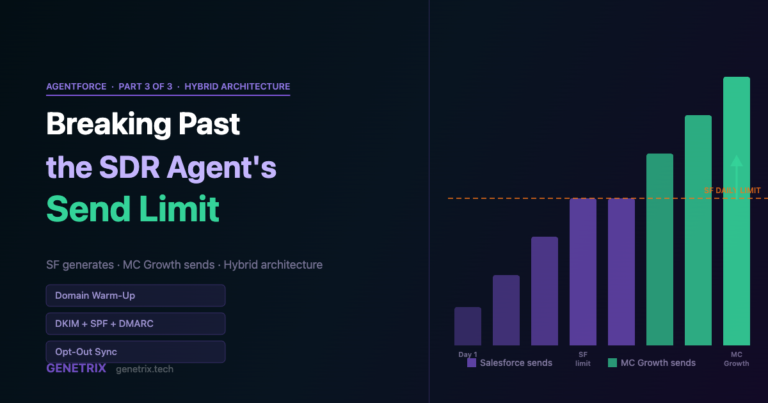
10. The Salesforce daily send limit still applies
For very high-volume nurture (say, 50k Leads/month), this becomes the architectural reason to consider sending through Marketing Cloud Growth instead.
08 — When This Is the Right Choice
And when to move to Marketing Cloud Growth
Use the Customer Engagement Agent on the Buyer Engagement template when: your org is already on Enterprise/Unlimited with Marketing Cloud Advanced; your nurture volume sits comfortably under Salesforce’s daily send limits; your campaigns are English; and you want a fully Salesforce-native loop where the Activity Timeline, Lead record, and agent conversation all live in the same place.
Move to the Marketing Cloud Growth pattern when: you’re sending at volumes that would blow through SF limits; you need to protect your transactional email domain reputation from outreach activity; or you need finer-grained per-recipient personalisation. That’s the next post in this series.
Ready to put it on your data?
We’ve built this pattern for B2B SaaS, fintech, and healthcare orgs. Each comes with its own constraints. Let’s talk through yours.