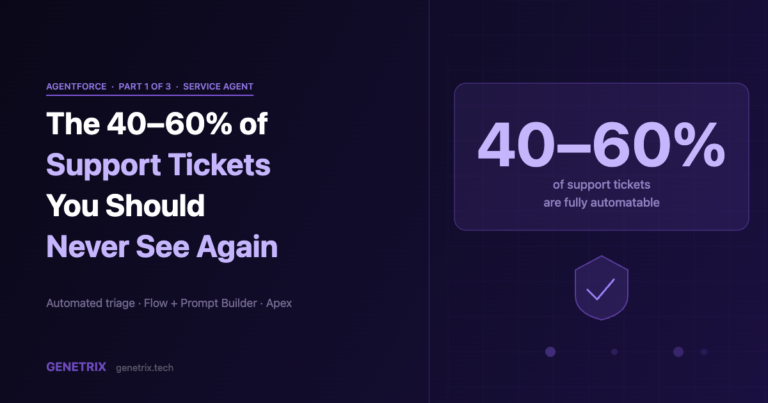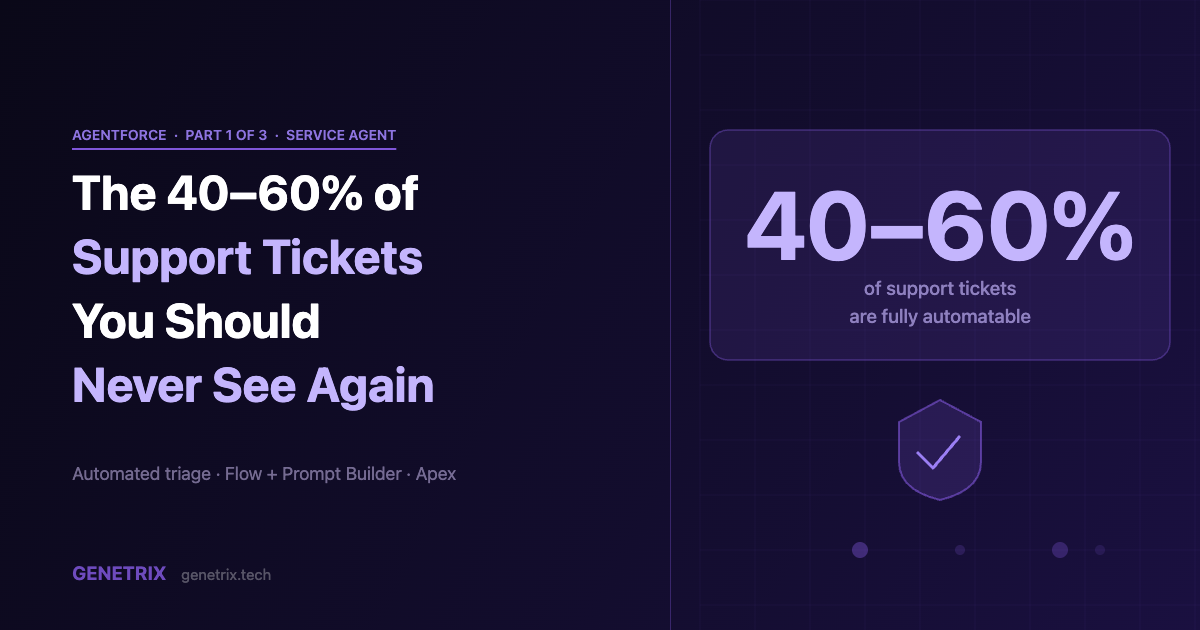
Most service teams aren’t drowning in hard tickets. They’re drowning in the same dozen polite, predictable questions arriving by email, all day, every day. “Where’s my order?” “Can I get a copy of the invoice?” “How do I cancel?” Routing those to a human creates two losses: the customer waits, and the rep burns attention they should be spending on the cases that genuinely need a human.
We’ve now shipped several variations of an autonomous email-to-case agent on Salesforce. The pattern is small, controllable, and entirely native — no external runtime, no extra licenses beyond what most Service Cloud orgs already have. This post walks through the architecture, the technical choices, and the limitations we’d flag for anyone building one.
01 — Why Not Just Turn on Agentforce Service Agent?
The lightweight alternative
Agentforce Service Agent (the OOB product) is excellent — but it’s also opinionated. It expects messaging channels, omni-routing, supervisor configuration, and a deployment surface that some orgs simply aren’t ready to stand up. For teams whose service starts and ends in email-to-case, that’s a lot of scaffolding to adopt for what is, mechanically, “read the thread and reply.”
The pattern we describe here is the lightweight alternative: a Flow trigger, a Prompt Builder template, an Apex send. It lives entirely inside the org you already have. It also gives you a clean upgrade path — when the team is ready for Agentforce Service Agent, the prompts, knowledge sources, and routing logic you’ve built can transfer over.
02 — Architecture at a Glance
Six steps, all native
The whole pattern fits on one diagram. An incoming email is parsed by Salesforce’s Email-to-Case service into an EmailMessage record with Incoming = TRUE. A record-triggered Flow fires on creation, gathers context, hands it to a Prompt Builder template, and writes an outbound EmailMessage back to the same Case via Apex. The customer receives a reply in their inbox, threaded against the original conversation.
email-to-case-flow.txt
Inbound Email
    → Email-to-Case (Native SF)
    → EmailMessage [Incoming = TRUE]
    → Flow Trigger on Create
    → Context: Case + History
    → Prompt Builder + Trust Layer
    → Apex: EmailMessage + sendEmail()
    → Outbound Reply
03 — The Trigger
Message records, not Cases
The first design decision worth being explicit about: we trigger on EmailMessage, not on Case. This sounds like a detail, but it matters. A Case is a container that lives across many turns of conversation. The unit of work for an agent is a single inbound message — and the only signal that one has just arrived is a new EmailMessage record with Incoming = TRUE.
Triggering on Case creation would only ever respond to the first email in a thread. Triggering on EmailMessage gives the agent every turn of the conversation, including replies to its own earlier replies.
flow-start-condition.apex
// Flow start condition:
Object:  EmailMessage
Trigger: Record is Created
Filter:  Incoming = TRUE
         AND Parent.RecordType = 'Standard Case'
         AND Parent.Status ≠ 'Closed'
04 — The Context Window
What we feed the model
The quality of the reply is set almost entirely by the context the agent sees before generating. We gather four things in the Flow:
The current inbound message — the body of the email that just arrived.
Prior messages on the same Case — ordered by created date ascending, capped at the most recent N (we typically use 10 or a token-budgeted truncation).
Case metadata — subject, type, priority, account, contact, related order or asset if applicable.
Relevant knowledge articles — pulled via a related-articles SOQL or a Data Cloud search index keyed on the case subject.
The fourth one is the difference between a generic-sounding reply and one that actually answers the customer. Without grounding in your own knowledge articles or policy data, the model will confidently make up return windows, SLAs, and refund eligibility rules. With grounding, it cites your real policy.
05 — The Prompt Builder Template
Shorter than you’d expect
The template itself is shorter than people expect. It’s not the LLM doing the heavy lifting — it’s the context. A working structure looks like this:
prompt-template.txt
## System
You are a customer support agent for {!Account.Name}.
Tone: {!Account.Brand_Voice__c}. Always polite, concise, factual.
Never invent policy. If unsure, escalate to a human.

## Case context
Case Number: {!Case.CaseNumber}
Subject:     {!Case.Subject}
Customer:    {!Contact.Name}
Order:       {!Case.Related_Order__c}

## Conversation history
{!Flow.Prior_Messages_Formatted}

## New inbound message
{!Flow.Current_Message_Body}

## Knowledge available
{!Flow.Related_Articles_Formatted}

## Your task
Write a reply to the new inbound message. If the question
cannot be answered confidently from the knowledge above,
respond with: ESCALATE.
That last instruction is critical. The model is given an explicit “I don’t know” path — and Apex listens for the ESCALATE token in the response. If it sees it, the Case is reassigned to a human queue and no email is sent.
06 — The Send
EmailMessage + Apex
Once the model returns a reply, an Apex action creates a new EmailMessage record with Incoming = FALSE, links it to the same parent Case via ParentId, sets ToAddress from the inbound message’s FromAddress, and sends via Messaging.sendEmail() using an Org-Wide Email Address.
OutboundEmailSend.apex
EmailMessage outbound = new EmailMessage(
    ParentId    = caseId,
    ToAddress   = inbound.FromAddress,
    Subject     = 'Re: ' + inbound.Subject,
    TextBody    = generatedReply,
    Incoming    = false,
    Status      = '3', // Sent
    MessageDate = System.now()
);
insert outbound;

Messaging.SingleEmailMessage mail = new Messaging.SingleEmailMessage();
mail.setOrgWideEmailAddressId(orgWideId);
mail.setToAddresses(new List<String>{ inbound.FromAddress });
mail.setSubject('Re: ' + inbound.Subject);
mail.setPlainTextBody(generatedReply);
mail.setReferences(inbound.MessageIdentifier);
Messaging.sendEmail(new Messaging.SingleEmailMessage[]{ mail });
Two details that matter: setReferences() with the inbound message’s identifier is how the reply threads correctly in the customer’s mail client. Sending via an Org-Wide Email Address keeps the reply branded as “Support” rather than “Apex Batch User.”
07 — Trust Layer & Guardrails
Keeping data in bounds
The Einstein Trust Layer sits between the Prompt Builder template and the LLM. The two settings that matter most for this pattern:
PII masking — order numbers, email addresses, and phone numbers in the prompt are tokenized before they leave the org, and re-hydrated in the response. The LLM provider never sees the raw values.
Zero data retention — Salesforce’s contracts with model providers prevent the prompts from being retained or used for training.
A support thread is often the densest concentration of PII in your org. The Trust Layer is what makes the difference between a compliant pattern and one that needs a careful chat with your CISO.
08 — The Eight Limitations We’d Flag
What to plan around
1. Token budget on long threads
A case with 30 prior messages will blow past the model’s context window. We truncate to the last 10 messages by default and use a token-counting helper to fall back further when needed. Losing context costs accuracy; carrying too much costs latency and money.
2. Hallucinated policy is the default failure mode
Without grounding in real knowledge articles, the model will confidently invent return windows, refund eligibility, and SLA commitments. Grounding isn’t optional; it’s the whole product.
3. Salesforce daily email send limits still apply
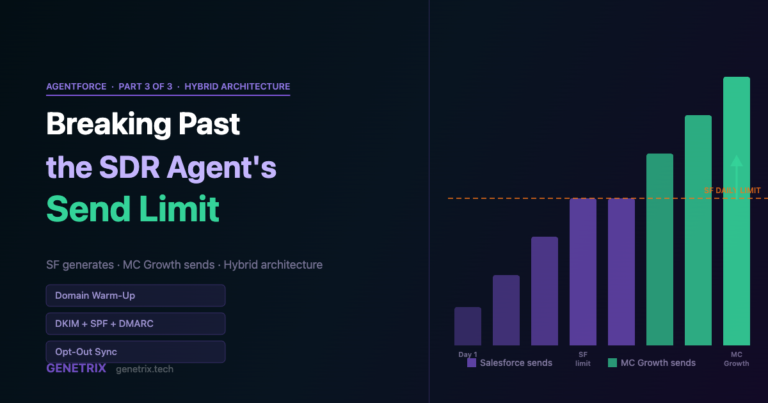
Most editions cap Messaging.sendEmail() at 2,000 external emails per day per org. A busy support inbox will hit that fast. For higher volumes, route through Marketing Cloud or a dedicated transactional provider.
4. Reply-loop risk with auto-responders
If the customer’s mail server sends an auto-reply, the agent will dutifully respond and you’ve built a feedback loop. Filter on FromAddress against known auto-responder patterns and check X-Auto-Response-Suppress headers before triggering.
5. Attachments are not read
If a customer sends a PDF invoice or screenshot, the LLM sees only the email body. Image-to-text and PDF parsing have to be added separately.
6. HTML email rendering is fiddly
Prompt Builder returns plain text by default. Wrap the model output in a Visualforce email template inside Apex. Don’t ask the model to write HTML directly — it will, and it will be broken.
7. Multi-language requires upstream detection
The Prompt Builder template is language-aware only if the prompt instructs the model. Pass a detected language code from the inbound message and template the system instruction accordingly.
8. Tone drift across thousands of conversations
Across volume, the model’s tone will drift toward a generic friendly-helpful baseline. Fix: an explicit brand-voice descriptor in the system prompt, and a sampling QA process where a percentage of replies are flagged for human review before send.
09 — When to Use This
And when to upgrade
This pattern is the right choice when your service is mostly email-to-case, your team isn’t ready to stand up Service Cloud Messaging + Omni-Channel, and you want a deployable autonomous responder in weeks, not quarters.
| Capability | This Pattern | Agentforce Service Agent |
|---|---|---|
| Time to first send | 2–3 weeks | 2–3 months |
| Channels | Email only | Email, web chat, WhatsApp, SMS |
| Multi-step reasoning | Single-turn replies | Native action chaining |
| Human handoff | Escalation flag → queue reassign | Native Omni handover with context |
| Cost | Trust Layer + storage | Agentforce Flex Credits |
See it running on your data.
Genetrix builds production-grade Agentforce patterns for Salesforce customers across Sales, Marketing, and Service. Book a live walkthrough on your sandbox.